Canada
Borough of Ahuntsic-Cartierville
February 2019 - January 2020
 15th.
15th.
The Borough of Ahuntsic-Cartierville conducted its first participatory budget from February 2019 to January 2020. This 1st Participatory Budget mobilized several organizations in the borough and more than 1000 people around innovative and collective projects.
At the heart of the project was the goal of "achieving higher levels of equality in participation and incorporating diversity as a criterion for inclusion". It was part of the principles of the Participatory Budget Charter: "Establish measures to promote the active participation of all social groups".
More than 1,000 people.
Ahuntsic-Cartierville is one of the nineteen urban boroughs of the city of Montreal, Quebec (Canada) with over 120,000 inhabitants. In 2019, the borough of Ahuntsic-Cartierville in Montreal launched its very first participatory budget. The goal of this process was to go beyond traditional consultations and allow residents to imagine, develop and choose for themselves the projects they considered most important to improve their living environment.
Residents were able to decide on the allocation of a portion of the borough's budget, namely $250,000. This amount came from the operating budget surplus, giving participants a great deal of latitude in the type of project that could be proposed (not limited strictly to development projects, unlike a participatory budget using money from the capital budget). In order to offer a process adapted to the reality of the borough, a steering committee composed of elected officials, local organizations, the two neighbourhood tables and borough staff was set up to formulate the principles that guided the entire process (transparency, accessibility and inclusion, development of the community and collective capacities, participatory democracy and power to act, and sustainable development), as well as the rules governing the exercise (the participatory budget charter).

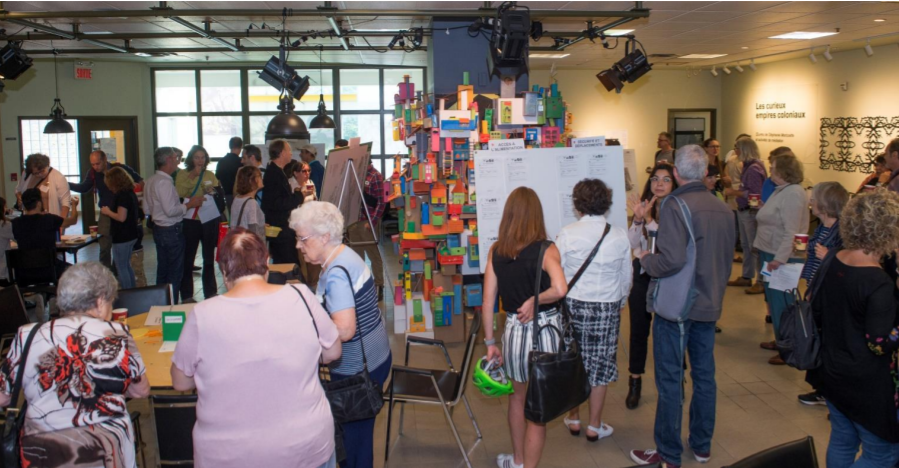
The population was first invited to propose ideas for projects aimed at improving their living environment, during ideation workshops and at a large outdoor public event, in the form of a participatory kiosk. Then, with the support of borough staff, the participants discussed and prioritized the project ideas during a large forum. Just over 250 people contributed to these first stages of the participatory budget.
After a feasibility study (technical, financial and legal) carried out by the borough's services, the projects were submitted to a vote open to all residents of the borough aged 12 and over. In one month, more than 1,000 people took part in the vote online (on the RealisonsMtl platform) or in person (in the borough's libraries or community centres, at borough offices, or during mobile voting sessions in schools, sports centres or seniors' residences). Three projects were selected by the population. They are currently being carried out, are in progress or will be shortly:
This project was the first in a recurring cycle of participatory budgets. Based on the lessons learned from this first edition, the borough of Ahuntsic-Cartierville is now implementing a second edition.
Evaluation
The Ahuntsic-Cartierville participatory budget was designed and carried out with a view to experimentation and learning. This is why, throughout the process, different ways of evaluating the approach were put in place: evaluation meetings with the steering committee and with the borough's internal teams, evaluation questionnaires during the activities of the approach and open commentary in plenary sessions and opportunities for the participants. A report on the process was produced and made public. It describes the participation in each of the activities and stages of the process, the resources invested, the socio-demographic statistics of the participants, as well as the detailed results.
Finally, the organization that accompanied the borough for the realization of the participatory budget, the Montreal Urban Ecology Centre, with its expertise in the realization of similar processes in several municipalities in Quebec, produced a summary report that contains judicious advice on the good results and the improvements to be made. All of this data is now being used to improve the process for the next edition and, more generally, our participatory practices in the borough.
Sources
"Although it should be pointed out that the participatory budgeting is not innovative in the strict sense of the word, as it is an experience that dates back several decades, it is innovative in the proposed district, and it should be noted that the differential quality of local implementation is that the participants have had a great deal of room for manoeuvre with regard to the type of project - not limited to investment projects. There is a lack of more precise mechanisms for evaluating the experience."
"As strengths we can point out the good methodology implemented, voting from the age of 12, the effort to achieve the participation of excluded groups and the clarity of the project. As limitations we can point out the low budget of 250,000 $, that is 1.5 $ / inhabitant, and three projects, and the difficulty to analyse the impacts as it is a recent project."






 Join the OIDP